
How to Move to South Korea: Your Complete Guiade (2026)
Korea is pulling more foreigners than ever. Tech jobs, K-culture, one of the fastest internet networks on the planet, and a brand-new digital nomad visa have put Seoul on the radar for remote workers, students, and expats from every corner of the world.
But "how do I actually move there?" gets complicated fast. Between visa paperwork, a deposit system unlike anything in the West, and a language barrier that hits hard on day one, there's a lot to sort out. And the order matters.
This guide covers the five things you need to figure out, step by step, so nothing catches you off guard. At Cove, we run furnished coliving spaces in Seoul and help foreigners settle in every week. Here's the roadmap we wish everyone had.
1. Pick your visa
Before anything else, you need a legal way to stay. Korea has several visa pathways depending on why you're moving. Here's a quick overview:
| Visa | Who it's for | Duration | Key requirement |
|---|---|---|---|
| E-2 (Teaching) | Native English speakers | 1 year | Bachelor's degree + TEFL cert |
| E-7 (Professional) | Skilled workers in tech, engineering, healthcare | 1-3 years | Employer sponsorship |
| D-2 (Student) | Full-time university students | Duration of program | University acceptance letter |
| F-1-D (Digital Nomad) | Remote workers for foreign companies | Up to 2 years | Income ≥ ₩88.1M/yr (~$66K) |
| H-1 (Working Holiday) | Ages 18-30 from 25 eligible countries | 12-18 months | Age + nationality |
| F-6 (Marriage) | Spouse of a Korean citizen | Renewable | Marriage certificate |
The two most common routes in are teaching English (E-2) and the digital nomad visa (F-1-D). Teaching is the easiest path. Your employer handles most of the paperwork and often provides housing. The digital nomad visa is newer (launched January 2024, now permanent) and increasingly popular with remote workers, but the income bar is high at roughly $66,000 per year from a foreign employer. One useful detail: you can switch from a tourist visa to the F-1-D at a local immigration office without leaving the country.
For professional work (E-7), you'll need to secure a job offer first. The company sponsors your visa. Student visas (D-2) are straightforward once you have a university acceptance letter, and they can transition into work visas after graduation.
Whichever route you choose, processing typically takes 3-4 weeks. Start early and don't book flights until your visa is confirmed. Full visa requirements and applications are available at HiKorea.go.kr.
2. Plan your budget
Seoul is more affordable than most people expect. It's roughly 20-30% cheaper than Tokyo or Singapore, and significantly cheaper than most major US cities. Here's what a typical month looks like for a single person:
| Category | Monthly range |
|---|---|
| Rent (studio) | ₩500K-₩1.5M |
| Food & groceries | ₩300K-₩600K |
| Transport (subway + bus) | ₩50K-₩100K |
| Phone plan | ₩30K-₩50K |
| Utilities | ₩80K-₩150K |
| Total | ₩1.5M-₩3M (~$1,100-$2,200) |
The biggest surprise for most foreigners is housing. The traditional Korean rental system often requires upfront deposits of ₩10 million to ₩50 million or more, which is a barrier most newcomers aren't prepared for. Your housing choice is by far the largest variable in your monthly budget, so it's worth understanding your options before you arrive.
3. Sort out housing
Housing is the single hardest part of moving to Korea as a foreigner. The traditional system assumes you have a Korean bank account, a local guarantor, and speak enough Korean to negotiate a lease. On day one, you'll have none of those things.
Here's how the main options compare:
| Traditional apartment | Goshiwon | Coliving / serviced | |
|---|---|---|---|
| Monthly rent | ₩400K-₩1M | ₩300K-₩600K | From ₩1,000,000 |
| Upfront deposit | ₩5M-₩50M+ | None-₩500K | None or minimal |
| Furnished | No | Basic | Fully |
| Lease length | 12+ months | Flexible | Monthly |
| Korean required | Yes | Minimal | No |
| Best for | Long-term, budget-conscious | Students, short stays | New arrivals, expats, digital nomads |
Traditional apartments are the cheapest option long-term, but the jeonse/wolse deposit system, language barrier, and guarantor requirement make them difficult to access as a newcomer. Most foreigners move into traditional housing after they've been in Korea a few months and have their bearings.
Goshiwon are tiny private rooms (roughly 3-5 square meters) with shared facilities. No deposit, no commitment. Just show up and move in. They're a solid option if you're on a tight budget or need something temporary while you look for longer-term housing.
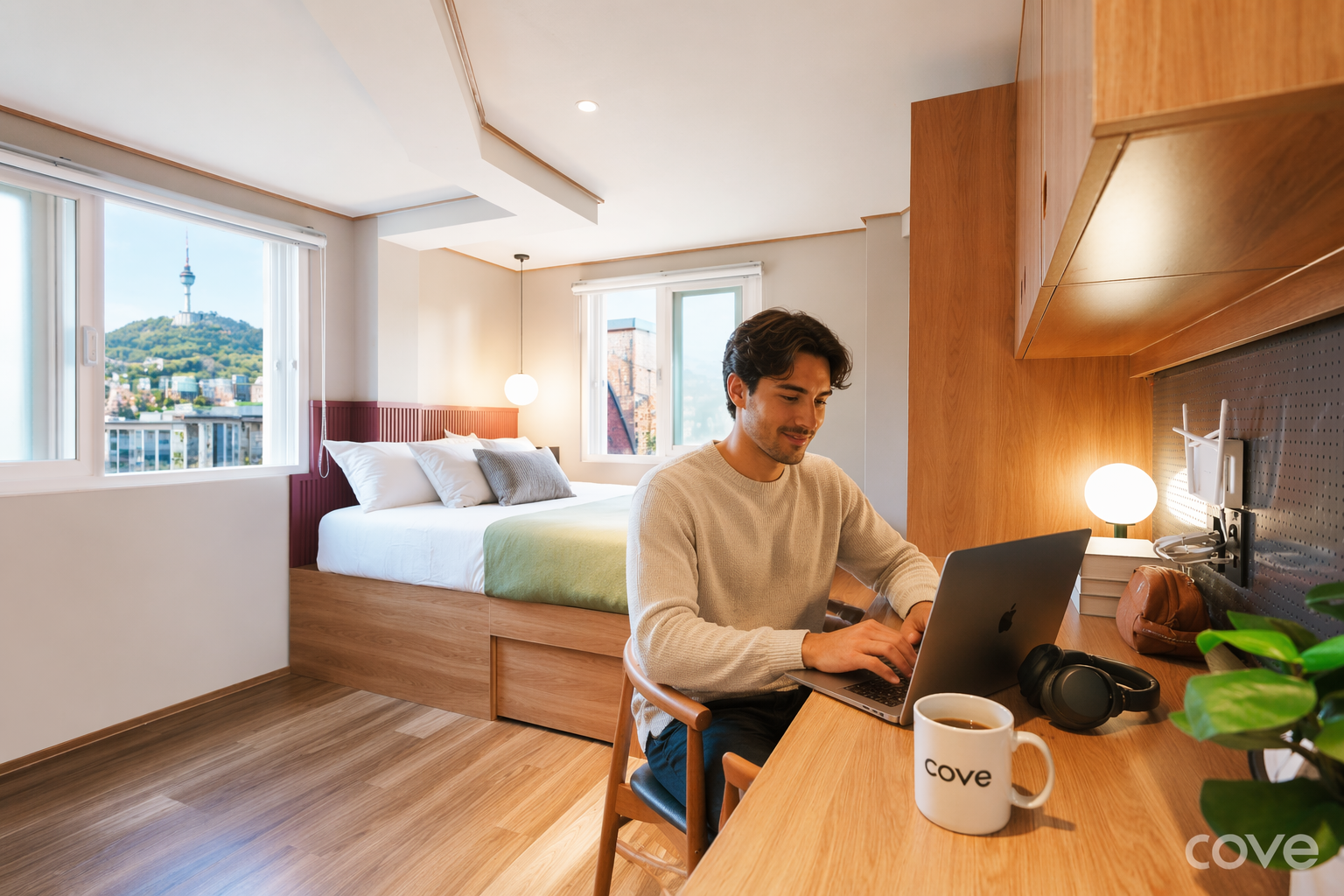
Coliving and serviced apartments cost more monthly but remove every friction point. At Cove, our studios in Yeonnam-dong and Seongsan-dong (Mapo-gu) start at ₩1,000,000 per month. Everything is included: furniture, WiFi, housekeeping, and maintenance. Contracts are monthly, no Korean bank account or guarantor needed, and you can move in within two weeks of booking.
Most people who are new to Korea start with coliving or a goshiwon, then transition to a traditional apartment once they've set up their bank account and learned how the rental market works.
4. Your first two weeks: the setup sequence
Once you land, there's a specific sequence to get fully set up in Korea. Each step unlocks the next, so order matters.
Step 1: Get a temporary SIM (day 1)
Buy a prepaid SIM or eSIM at Incheon Airport. You only need your passport, no Korean ID required. KT and SKT sell prepaid plans starting around ₩8,800 for 1GB of data and 100 minutes of local calls. This gets you connected while you sort out the rest. Pick up a T-money card at any convenience store too (₩2,500-₩4,000). It works on every subway and bus in the country.
Step 2: Apply for your Residence Card (as early as possible)
Your Residence Card (formerly called the Alien Registration Card or ARC) is your Korean ID. You need it for everything: banking, phone contracts, health insurance, even online shopping.
Book your immigration appointment at HiKorea.go.kr as soon as you arrive. Slots fill up fast in Seoul, so don't wait. You'll need your passport, a photo (3.5 × 4.5 cm, white background, ears visible), proof of your address, and ₩30,000-₩35,000 for the fee. Some visa types also require a tuberculosis medical check.
Processing takes 2-4 weeks after your appointment. One important detail: if you have a single-entry visa, you cannot leave Korea until your Residence Card is issued. Your visa would be cancelled at the airport. And don't miss the 90-day deadline to apply. Late registration carries fines of ₩100,000 up to ₩1,000,000.
Step 3: Open a bank account
Once your Residence Card arrives, head to a bank branch in person. Remote account opening isn't available for foreigners. The most foreigner-friendly options are KEB Hana (their "Easy-One" account has English support), KB Kookmin, Shinhan, and Woori. Bring your passport, Residence Card, and Korean phone number.
Ask to set up a "Foreign Designated Bank" if you plan to send money internationally. Without this designation, overseas transfers are blocked. Heads up: new foreign accounts start with low daily transfer limits. Bring proof of employment or income to get those limits lifted faster.
Step 4: Get a real phone plan
With your Residence Card and Korean bank card in hand, you can now upgrade to a postpaid plan from SKT, KT, or LG U+. For a more affordable option, consider MVNO carriers (알뜰폰) like Woori Mobile. They run on the same major networks but at a fraction of the price. Some plans come out to around ₩40,000 for three months of unlimited data.
Step 5: Download the essentials
Four apps you'll use every day: KakaoTalk (Korea's default messaging app, and not having it is like not having a phone number), Naver Map (works far better than Google Maps in Korea), Papago (Naver's translation app, more accurate for Korean than Google Translate), and your bank's mobile app for transfers and payments.
5. What to expect
A few things that are good to know before you go:
Korea is one of the safest countries in the world. People routinely leave laptops and wallets unattended in cafes. The food is incredible and affordable; a solid restaurant meal runs ₩6,000-₩10,000. You don't need to be fluent in Korean, but learning Hangul (the alphabet) takes a weekend and makes daily life noticeably easier. Free government Korean classes are available once you have your Residence Card.
Weather-wise, spring and fall are beautiful. Winters are genuinely cold (down to -10°C in Seoul) and summers are hot and humid. And if you're worried about finding your people, don't be. Seoul has active expat communities in Hongdae, Itaewon, and Mapo, with regular meetups and social events.
Ready to make the move?
Moving to Korea isn't complicated. It just needs to happen in the right order. Get your visa sorted, find a home base, and the rest falls into place.
If you want to skip the housing headaches and start with a furnished, flexible setup, explore Cove's rooms in Seoul →